
Court Process
Guardianship Court Process
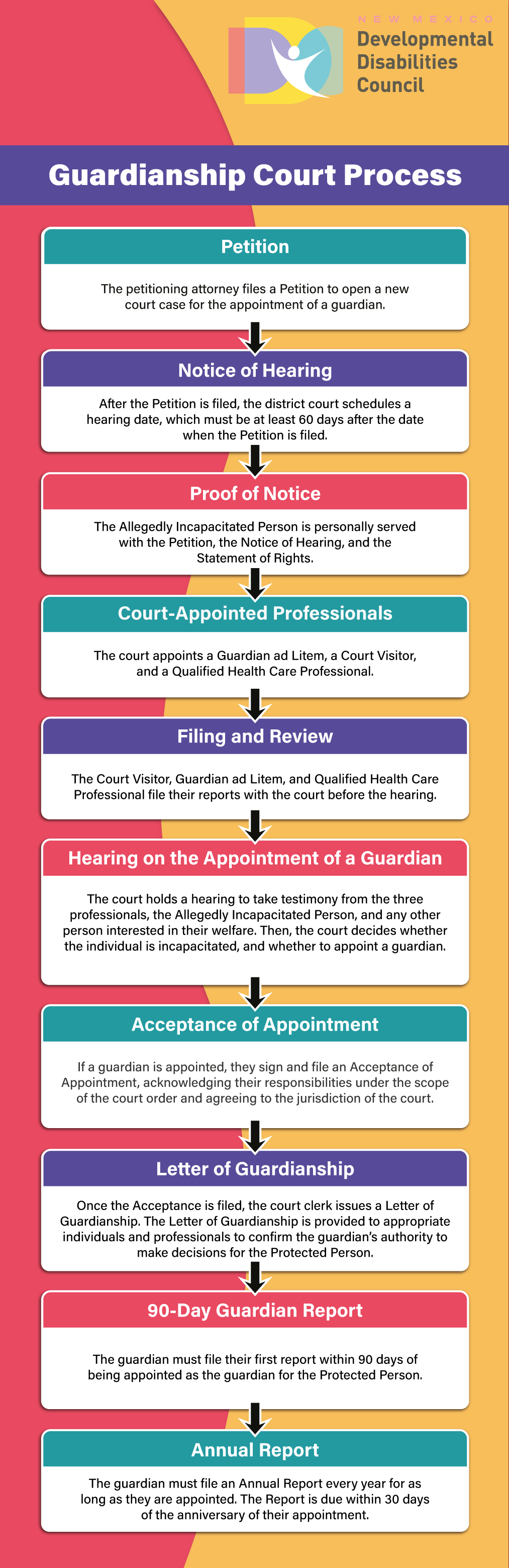
- Petition for Guardianship
The Petition for Guardianship is the formal request filed with the Court to appoint a guardian for an Allegedly Incapacitated Person. The Petition states why the person may need a guardian, identifies a proposed guardian, and lists specific people who may be interested in the welfare of the Allegedly Incapacitated Person. - Notice of Hearing and Rights
Within five days of the Petition being filed, the court must issue a document called a “Notice of Hearing and Rights,” outlining the purpose of the hearing and scheduling a date for the hearing. The date cannot be any sooner than 60 days from the day the Petition was filed. - Personal Service and Service on Interested People
The Allegedly Incapacitated Person must be hand-delivered two documents: the Petition and the Notice of Hearing and Rights. Hand delivery of these documents is called “personal service.”
These documents must also be provided to the individuals interested in the welfare of the Allegedly Incapacitated Person. Instead of personal service, the documents can be mailed to those individuals. - Court-Appointed Professionals’ Written Reports
The court will appoint three professionals to assist in determining whether the Allegedly Incapacitated Person needs a guardian: a Guardian ad Litem (or “GAL,” who is an attorney), a Court Visitor (or “CV”), and a Qualified Health Care Professional (or “QHCP”). It is their job to review and assess the person’s situation, to what extent the person may be incapacitated, whether appointment of a guardian is appropriate, and what scope of decision-making authority an appointed guardian should have. The GAL, CV, and QHCP each must file a written report with the court before the hearing date. - The GAL reviews the proposed guardian’s suitability and whether appointment of that person or agency is in the best interests of the person who may need the guardian. The CV visits the location where the Allegedly Incapacitated Person currently lives. If the Allegedly Incapacitated Person may move to a new residence when the guardian is appointed, the CV also visits the possible new residence. The GAL and CV reports include details on the professionals’ interviews with the Allegedly Incapacitated Person, and anyone else who may have important information about the person’s circumstances.
- For Office of Guardianship cases, the QHCP report is generally filed with the Petition.
- Required Training for Proposed Guardians
Before the hearing on the Petition, New Mexico Courts require every proposed guardian to watch a series of videos in the Courts’ “Adult Guardian and Conservator Orientation Program.” The proposed guardian must then file a “Notice” with the Court confirming they have watched the videos. Information on the videos and the Notice is available here: https://adultguardianship.nmcourts.gov/about/orientation-program/.
Guardians to be appointed in the Second Judicial District (Bernalillo County) also must complete the Elder and Disability Initiative (“EDI”) training. This is a one-hour training, offered twice each month, conducted by video and in person. offered twice each month, separate training . In addition, individuals who may be appointed as a guardian through a professional agency must be certified and in good standing with the Center for Guardianship Certification. - Court Hearing on Petition for Appointment
The hearing to decide whether an Allegedly Incapacitated Person needs a guardian must be held at least 60 days after the Petition is filed. Unless the court determines otherwise, the Allegedly Incapacitated Person must attend the hearing. (If the Allegedly Incapacitated Person is unable to attend the hearing, the Court may order the hearing to take place where the Allegedly Incapacitated Person is). The Court will review the professionals’ reports, hear from the proposed guardian and other people, and speak directly to the Allegedly Incapacitated Person. Unless the Court finds good cause to order otherwise, the hearing to appoint a guardian is open to the public. - Appointment of a Guardian
The Court will appoint a guardian for the Allegedly Incapacitated Person if it finds that three things are true: (1) the Allegedly Incapacitated Person is incapacitated; (2) the person needs someone to assist with their decision making; and (3) no other alternatives to guardianship would work.
The scope of decision-making authority granted by the Court will be either “limited” or “full,” depending on what sorts of decisions the person needs assistance with and what is the least restrictive level of support. - Acceptance of Appointment
An “Acceptance of Appointment” is a pleading signed by the appointed guardian. By signing the Acceptance, the guardian acknowledges they are agreeing to be appointed as guardian, they are willing to act in accordance with the Court’s order appointing them as guardian, and they are subject to the jurisdiction of the Court that appoints them. - Letter of Guardianship
The “Letter of Guardianship” is a document issued by the Clerk of the Court after a guardian is appointed and files the Acceptance. The Letters outline the guardian’s appointment and the specific scope of their decision-making authority. Health care providers, banking institutions, the Social Security Administration, and other entities typically require a copy of the Letters. - 90-Day Guardian Report
Ninety days after their appointment, every guardian must file a written report about the Protected Person and the decisions that the guardian has made. The report must be completed by using the Court’s form, found at this link. (También disponible en español aquí). - Annual Report
Each year, within 30 days of the anniversary date of their appointment, every guardian must file an updated written report about the Protected Person and guardianship decisions made during the previous year. This form is the same as the Initial Guardian Report form. - 10-Year Status Review
At least once every 10 years the court will hold a status hearing to check on the protected person, their circumstances, their level of capacity, and whether they still need or benefit from a guardianship.